
Relationships are tricky!
One of the reasons they are tricky is that fundamental to a good relationship is the ability to communicate…and communication is also something most of us find hard – particularly when it gets personal and we have to be vulnerable. But, without honest, personal and vulnerable communication relationships don’t work.
On the flip side, the mark of a healthy, stable and flourishing relationship is that you are able to communicate in the good and the bad, the rough and the smooth, the happy and the sad, when angry or at peace, when restless or when content…and everything in between. If the communication lines fail (you stop speaking) or go into overdrive (with an explosion of anger) there will be damage to the relationship. The damage might be an instantaneous wound/wall that develops through a sharp word spoken in a moment of anger, or a slow-hardening wall developing as communication breaks down and you stop sharing. So fundamental to making relationships work is communication.

And it is no different in our relationship with God…we must learn to communicate with Him in an honest, personal and vulnerable way. The primary way we hear God speaking to us is through the Bible and then we respond to what He says in His Word through prayer. Now I have never met anyone who found prayer easy. Prayer, like learning to communicate well in relationships, takes work and most of us need input from others to help us grow in communication skills (Leanne and I spend a whole evening on the marriage enrichment course talking about communication and conflict). And that is what the Psalms are about. They are God’s way of helping us pray. He is our guide and counsellor who is giving us words that we can use to communicate with Him. And we can communicate with Him in all seasons of life and in all the emotions we feel.
John Calvin, a very famous Bible teacher from the 16th Century, put it like this in his Commentary on the Psalms:
I have been accustomed to call this book, I think not inappropriately, “An Anatomy of all the Parts of the Soul;” for there is not an emotion of which anyone can be conscious that is not here represented as in a mirror. Or rather, the Holy Spirit has here drawn to the life all the griefs, sorrows, fears, doubts, hopes, cares, perplexities, in short, all the distracting emotions with which the minds of men are wont to be agitated.
A modern commentator on the Psalms, Tremper Longman, says this in his book “How to Read the Psalms”:
The Psalms appeal to the whole person; they demand a total response. The Psalms inform our intellect, arouse our emotions, direct our wills and stimulate our imaginations. When we read the Psalms with faith we come away changed and not simply informed. Of course, the whole of Scripture is radically life-changing, but the Psalms address the modern Christian in a more direct way than, say, the last half of Joshua which details the geographical boundaries of the twelve tribes of Israel.
C.S. Lewis, in his book on the Psalms, notes the importance of singing the Psalms:
The Psalms are poems, and poems intended to be sung: not doctrinal treatise, or even sermons
Of course, the Psalms contain plenty of great doctrine and can be the basis of a great sermon (we are hopefully going to have 5 such great sermons!) but they engage us differently than a sermon. When we sing we emotionally enter into the truth we are singing differently from when we are just hearing that truth. It’s easy to hear the truth in our heads but not let it travel to our hearts. The Psalms help us with that journey.

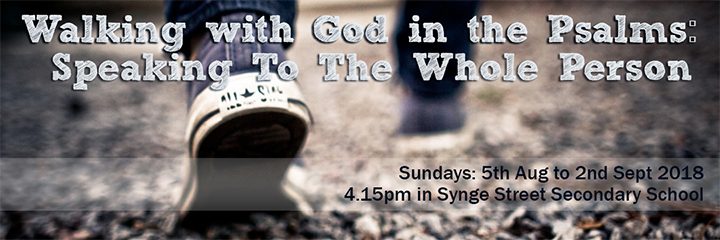
So, as is our custom each summer, we are going to put five weeks aside to look at the Psalms to help us to pray, to help us to be honest, personal and vulnerable with God, so that we can grow in our relationship with Him. Here are the talks for the next five weeks:
- 5th August – Psalm 139 – The God who knows me
- 12th August – Psalm 23 – The Lord is my Shepherd
- 19th August – Psalm 73 – Why do the wicked prosper and the righteous suffer?
- 26th August – Psalms 146-150 – Why and how should we worship God? (Family Service)
- 2nd September – Psalm 108 – Praying when you need courage (for new initiatives and ventures)
Do join us at Synge Street at 4.15pm on Sundays as we learn together.
If you want to pursue some personal study/devotion alongside the series, I suggest you take a look at these books:
- My Rock, My Refuge by Tim and Kathy Keller
- God’s Prayer Book – the power and pleasure of praying the Psalms by Ben Patterson
- Favourite Psalms – growing closer to God by John Stott
- Finding God in the Psalms – sing, pray, live by Tom Wright
- Answering God: The Psalms as a tool for prayer by Eugene Petersen
- Praying with the Psalms: a year of daily prayers by Eugene Petersen
If you want to revisit the blogs and podcasts from previous years, here are the Psalms we have covered before:
- 2015 – Walking with God in the Psalms: From self to community (Psalms 46, 62, 77, 93, 110)
- 2016 – Walking with God in the Psalms: Songs for the road – (The Songs of Ascents – Psalms 121, 123, 125, 127, 131)
- 2017 – Walking with God in the Psalms: Prayers for all seasons of life
- Psalms 13, 104, 74, 138, 87)
- 2017/2018 – Walking with God in the Psalms: Prayers for all seasons of life (Psalms 139, 23, 139, 73, 108, Psalms 145-150)
Yes! My favourite series is back. Looking forward to listening online.