
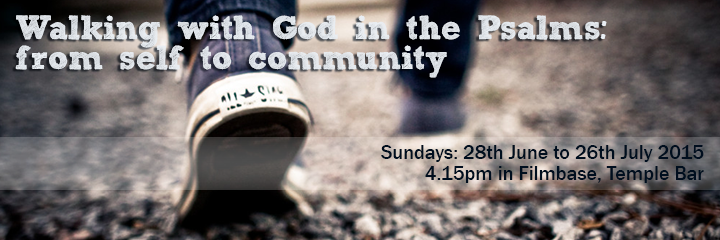
Each summer as a church we spend five or six weeks in the Psalms. Why? Because we all need help in prayer and the Psalms are God’s prayer book: words he has given us, for all circumstances of life and for all the emotions we feel, in order to pray to him. In this particular series we’re going to pick up on a theme that Eugene Peterson draws out from 11 Psalms in his book Where Your Treasure Is – Psalms that summon you from Self to Community.
Let me put the series in context, explain how the Psalms can help us move from Self to Community and outline the five different weeks.
Walking with God
One of the first metaphors in the bible to describe our relationship with God is walking. Genesis 3:8 says:
Then the man and his wife heard the sound of the Lord God as he was walking in the garden in the cool of the day, and they hid from the Lord God among the trees of the garden.
Notice how God comes walking to them but, since they had sinned, instead of running towards him for an embrace, they run away and hide. Before our sin and all the condemnation and shame that followed, we walked with God in the cool of the day. Now, due to the distance we feel in relationship to God, we hide from him.
However God still comes walking towards us. God is still initiating and still wants a relationship. He wants to find us, he wants to forgive us, he wants to heal us, he wants to embrace us and he wants to set us free from our hiding. But for him to do that, we need to stop hiding.
 Now there are many reasons why we may hide from God. We may be angry at him for the suffering we have experienced. We may feel full of shame for the mistakes we have made. We may get distracted and caught up in pointless pursuits and ignore him. All these are true and I am sure there is much more. But worse still, the reason I can hide so well, is that I don’t know what to say to him when I feel disappointed or angry. I don’t know what to say to him when I feel full of shame and condemnation. I don’t know what to say to him when I am self-absorbed and distracted. And because life has so many ups and downs, how do I process the violence and tragedy and disappointment on the one hand and the beauty, wonder and joy on the other hand? How can I keep walking with God? I know from my own life and experience that my relationship with God falters and struggles is because I am not sure how to relate to him. I have a prayer problem!
Well the Psalms are the answers to this problem. Again God has initiated, God has come to us, but this time he has come to give us words that we can pray in every season of life. God wants to give us words that we can use to keep us walking with him. The Psalms are a collection of 150 different songs and prayers that we first used by Israel 3500 years ago and have been used ever since by God’s people to keep them walking with God.
If you struggle to pray you’re in good company, it’s something the disciples struggled with and that is why they asked Jesus “Lord teach us to pray” (Luke 11:1). However God’s answer to our prayer problem was to give us 150 prayers that we could get become familiar with, memorise, internalise and re-use, to keep us walking with God. Even Jesus himself used them to help him pray!
So let’s consider one particular aspect of praying the Psalms…
From Self to Community
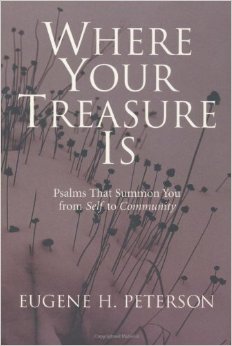 In 1993, with the USA in mind, Eugene Peterson (author of The Message bible) picked 11 Psalms and applied them to his congregation as a call for them to leave behind their selfishness and greed, and become more concerned with God and the community. He writes:
I have written to encourage Christians to pray them [the psalms] both as children of God with eternal destinies and as …citizens with daily responsibility in caring for our nation
He said that everyone of us was in need of “unselfing,” of becoming less pre-occupied with our own promotion and security and more concerned with others and the community. He comments about how the different disciplines of psychology, sociology and theology reveal that problem of the deterioration of our public life and personal lives is due to a ‘self problem’. He says everyone is agreed on that and then he says we need to look to our ancestors (not politics!) for the solution:
The striking diagnostic consensus of modern experts that we have a self problem is matched by an equally striking consensus among our wise ancestors on a strategy for action: the only way to get out of the cramped world of the ego and into the large world of God without denying or suppressing or mutilating the ego is through prayer. The only way to escape from self-annihilating and society egotism and into self-enhancing community is through prayer. Only in prayer can we escape the distortions and constrictions of the self and enter the truth and expansiveness of God. We find there, to our surprise, both self and society whole and blessed. It is the old business of losing your life to save it; and the life that is saved is not only your own, but everyone else’s as well.
Peterson was writing these words in 1993. Over 20 years’ later we need to hear them more than ever before. Through this series we’re going to hear the summons of five Psalms that call us out of our self and into community, both the church community but also the wider community of Dublin.
In his introduction Peterson challenges the idea that “prayer is private”. The Psalms confront us with the reality that prayer is not private, in the sense that we want to insulate ourselves from interference and to ensure we’re not ‘bothered’ by other people. Whilst we may pray in solitude, being alone to pray is so we can listen to others and service others more attentively. Private prayers are thin and selfish, prayer in solitude is generous and has the community in mind. Similarly whilst the Psalms are concerned about the wellbeing of my life and soul their scope is far wider, they help us pray “your kingdom come on earth”.
Talking about the way the Psalms have been compiled and edited Peterson says:
Two Psalms are carefully set as an introduction: Psalm 1 is a laser concentration on the person; Psalm 2 is a wide-angle lens on politics. God deals with us personally, but at the same time he has public ways that intersect the lives of nations, rulers, kings and governments. The two psalms are together by design, a binocular introduction to the life of prayer, an initiation into the responses that we make to the word of God personally (“blessed is the man” 1:1) and politically (“blessed are all” 2:11).
He ends his opening chapter by saying:
Our citizenship is in heaven” say those who pray…but this passion for the unseen in no way detracts from their involvement in daily affairs: working well and playing fair, signing petitions and paying taxes, rebuking the wicked and encouraging the righteousness, getting wet in the rain and selling the flowers.
The Psalms, in every way, move us from ourselves to others and community. In our prayers we’re to unite what is usually separated, self and society, personal and public.
So let’s summarise what we’re going to learn from the five weeks…
Five Lessons from five Psalms (Sunday 28th June – Sunday 26th July)
- Psalm 46: Praying in chaos & collapse – whether it is global (the chaos of nations falling under the financial crisis) or personal (my heart fears as things around me collapse) we need to know that The Lord Almighty is with us and to be still and know that he is God. Once we know this, we will not fear and we’ll be able to discern that he is building an unshakeable kingdom/city within the mess.

- Psalm 62: Praying in the waiting – none of us like waiting, particularly when others are getting ahead, and especially if they are doing that by false means. Psalm 62 helps us centre ourselves on God and wait for his timing and action. We are not to assert ourselves, but to find rest (silently) in God. We’re to know him as our rock and salvation, a fortress that cannot be shaken.
- Psalm 77: Praying to combat self-pity – we’re all prone to self-pity. In different ways we feel overlooked, taken-for-granted, hurt and left-out. Sometimes this is not true (it’s just our ego that has been bruised) and sometimes it is true (we haven’t been treated right). It’s vital that we don’t wallow in self-pity which turns to bitterness and hardness of heart towards God and others. This Psalm will help us come out of the cul-de-sac of self-pity.
- Psalm 93: Praying when I want to be in charge – it’s hard to surrender your whole life to God and trust that he knows best. Even Jesus wanted the cup of suffering to be taken away from him as he contemplated the cross and yet he prayed “not my will but yours be done”. This Psalm helps us focus our hearts and minds on the reality that “Our God Reigns” – that he is sovereign and that no-one else is in charge.
- Psalm 110: Praying when I want to fix the world – this Psalm is quoted more than any other Psalm in the New Testament (seven times with other allusions) and it speaks about the perfect King and Priest. A king who rules in a way that brings blessing to nations and a priest who serves in a way that connects people to God. This is what Israel and the church were supposed to be (Exodus 19:4-5 and 1 Peter 2:9) and therefore this Psalm helps us pray to that end. But ultimately we need to realise that it’s Jesus, the perfect king and priest, who will establish God’s kingdom on earth and bring people to God. As we rest in him we can actually do good in this world!

So there you have it. I hope to see you on one of the Sundays and at our prayer meeting on 13th July. May Jesus teach us to pray and may we walk more closely with God as a result of these five weeks in the Psalms!