
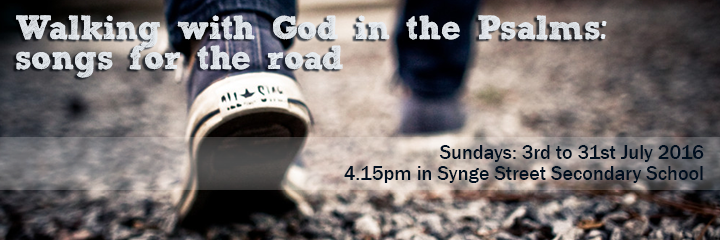
Each Summer we do a short series in the Psalms to help us to grow in prayer and grow in our relationship with God.
None of us find prayer easy, we’re often not sure what to pray for or how to pray. We often find we get distracted in prayer or we don’t want to pray. God’s answer to our inability to pray was to give us the Psalms: 150 songs and prayers that have been used over 3000 years to help God’s people to relate to him in all circumstances. Whether you’re feeling up or down, whether life is going well or horribly, whether you feel close to Jesus or not, the Psalms will give you words to express your emotions and thoughts and draw near to God. If you want to learn to pray, if you want to draw near to God, use the Psalms… he gave them to us for that very purpose!
Jesus & The Psalms
If you’re not convinced that you should use the Psalms in your prayer life then you’d do well to look at Jesus’ own prayer life. He regularly runs to the Psalms to find words which will help him speak to his Father in heaven. We know he sang a hymn with his disciples at the last supper (Mark 14:26) which was most probably one of the Passover Psalms (Psalm 113 – 118) since it was passover time. And then on the cross, in his hour of greatest need, where does he turn to help him pray? The Psalms. On the cross he quotes three different Psalms (22:1, 31:5, & 69:21).
It’s no surprise that the early church used Psalms in corporate worship (Colossians 3:16, 1 Corinthians 14:26).
The Songs of Ascents
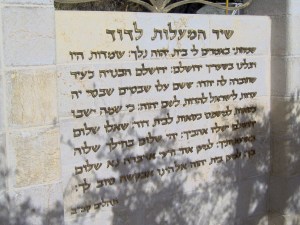
One of the Songs of Ascents, Psalm 122 appears in Hebrew and English on the walls at the entrance to the City of David, Jerusalem, Israel.
This summer we’re going to focus on a group of Psalms called ‘The Songs Of Ascents’ (Psalms 120-134) which are 15 Psalms that were sung by The Jewish Pilgrims as they made their way to Jerusalem three times a year for the three annual festivals (Exodus 23:14-17, 34:22-24). No doubt Jesus sang these Psalms as a young boy and teenager as he went to Jerusalem with his family to join the festivals (Luke 2:41-42).
Jerusalem was the highest city in Palestine, and all who traveled there spent much of their time ascending. And as they journeyed from their towns to Jerusalem they sang these songs until they came to the temple to join in the festival and the celebration. These were their songs for the road. Isaiah 30:29 captures the essence of the songs of ascent well when it says:
And you will sing as on the night you celebrate a holy festival; your hearts will rejoice as when people playing pipes go up to the mountain of the Lord, to the Rock of Israel.
Or earlier Isaiah 2:3 says:
Come, let us go up to the mountain of the Lord, to the temple of the God of Jacob. He will teach us his ways, so that we may walk in his paths.
For us Christians the journey and the ascent is now not to Jerusalem and to the temple, but we travel along the way of Christ to meet with God himself. Jesus is the way (John 14:6) and he leads us along the narrow path to life and eternity (Matt 7:13-14). God now dwells not in a temple in Jerusalem but in Christ (John 2:19), in us (1 Corinthians 6:19) and in his church (1 Corinthians 3:17). Because of Jesus’ sacrifice we have direct access to God’s presence through prayer (Hebrews 10:19-22).
But as you will know, the Christian walk is not easy. Just as the Jewish pilgrims faced enemies, physical weariness, internal quarrels, indwelling sin and emotional exhaustion, so too the follower of Christ finds the narrow way of obedience is full of the same challenges. But it was for these reasons that the songs of ascents were given, to sustain the pilgrims on their journey and to bring them to their destination; the joy, peace and prosperity of Jerusalem. So we too are given these Psalms to sustain us and lead us to joy, peace and prosperity in Christ.
An Upward Journey
Not only was the journey to Jerusalem upwards, but the Psalms themselves take us upwards in our souls by the way they have been structured. The 15 songs of ascents have been grouped into threes (e.g 120-121-122 are followed by 123- 124-125) and each group of three follows a similar pattern, as follows:
- Trouble (e.g. Psalm 120:6 “too long have I lived among those who hate peace”)
- Prayer (e.g. Psalm 121:2 “my help comes from the Lord, the Maker of heaven and earth”)
- Salvation (e.g. Psalm 122:8: “for the sake of my brothers and friends I will say “peace by within you”)
Additionally the structure of the Psalms, both spiritually and physically, is a journey from exile to homecoming (like the prodigal son story).
- Exile (e.g. Psalm 120:5 “woe to me that I dwell in Meschech, that I live among the tents of Kedar” – Meschech and Kedar are enemy territory for the Psalmist)
- Journey (e.g. Psalm 121:3 “He will not let your foot slip”)
- Homecoming (e.g. “Our feet are standing in your gates O Jerusalem” – for the Pilgrims Jerusalem was the place of peace and prosperity, of joy and security)
And this upward journey can be made in many ways today
- From fear to faith
- From bitterness to love
- From despair to hope
- From loneliness to community
- From darkness to light
- From vulnerability to stability
God wants us to use the songs of ascents to help us make our way along the road with him and to him, and to greater peace and prosperity in our souls.
Tourists vs Pilgrims
Eugene Peterson in his classic book on the Songs of Ascents, A Long Obedience in the Same Direction, compares the journey motif (which has inherent within it the idea of delayed gratification) with our modern desire for instant results and satisfaction. He says we have a tourist mentality, not a pilgrim mentality. He writes:
We assume that if something can be done at all, it can be done quickly and efficiently. Our attention spans have been conditioned by thirty-second
commercials… Religion in our time has been captured by the tourist mindset. Religion is understood as a visit to an attractive site to be made when we have adequate leisure.
He goes on to say:
Everyone is in a hurry. The persons whom I lead in worship, among whom I counsel, visit, pray, preach and teach, want shortcuts. They want me to help them fill out the form that will get them instant credit (in eternity), They are impatient for results. They have adopted the lifestyle of a tourist and only want the high points.
So we must change our tourist mindset for a pilgrim mindset:
Pilgrim tells us we are people who spent our lives going someplace to God, and who the path for getting there is the way, Jesus Christ. We realise that “this world is not my home” and set out for the “father’s house”. Abraham who “went out” is our archetype.
Five week series (3rd July to 31st July)
So this is how our five weeks in July are going to be split up:
3rd July: Psalm 121 – Praying Under Pressure
10th July: Psalm 123 – Praying Under Opposition
17th July: Psalm 125 – Praying In Uncertainty
24th July: Psalm 127 – Praying In Our Work
31st July: Psalm 131 – Praying In Our Restlessness
I hope you’ll enjoy it as we journey together through the songs of ascents and grow closer to God as a result.
[*later note – all the talks from this series can be found here if you want to listen back*]
—-
Suggested Reading – Eugene Peterson, A Long Obedience In The Same Direction
Daily Devotionals – My Rock, My Refuge by Tim and Kathy Keller
Previous Posts
- Five part series called “why meditate on the Psalms?” – Part 1, Part 2, Part 3, Part 4 & Part 5
- Bonhoeffer on The Psalms
- The Psalms – From Self to Community (summer 2015 series)