

This coming Sunday we start a short three-week series called ‘Different: loving those you disagree with’, looking at Romans 14 & 15. Let me put the series in context, summarise what we’ll be learning each week and highlight the issues that we’re going to tackle.
(1) Context – Ancient and Modern
 There is both an ancient and modern context that I want to consider briefly. In terms of our present day Ireland we have just had the world-famous and historic referendum where the people of Ireland voted resoundingly in favour of gay marriage. However, as the Spectator wrote in the run up to the vote, “Ireland’s ‘tolerant’ elite now demonise anyone who opposes gay marriage” and the Independent wrote after the vote “the striking thing about the yes camp was its intolerance“. I am all for tolerance, equality and fairness and it’s great that the people of Ireland want that. However, true tolerance does not mean we all have to agree with each other (that’s conformity!) and it certainly doesn’t mean that we should demonise those who disagree with us. True tolerance means that whilst you try to persuade others to your position, should those people remain unchanged in their view (their conscience), you love and respect them nonetheless. You treat them as equals despite your difference of opinion. I think there are some lessons we need to learn here.
One other significant learning point from the referendum is that the feeling of being on the ‘outside’ is a very dehumanising experience. That is how the LGBT community have felt for years. They have felt less than equal, not accepted, not loved, not noticed and not cared for. There has been great fear in ‘coming out’ because of the ridicule, shame and ostracism that might follow. So when the people of Ireland said “Yes” there were many of the LGBT community that said they finally didn’t feel on the outside, they didn’t feel second rate, they didn’t feel less valued in Irish society. Again, there are lessons for us to learn here – how can we disagree with one another without ostracising those in the minority? We must not make the same mistake again and allow another people group in society to feel like they are left out, on the outside, lesser citizens.
 Now let me turn to the ancient context of Romans 14-15. In the Apostle Paul’s day, the issue he was tackling on a daily basis was the unity of Jews and Gentiles. Two people groups who for centuries had been separated, often with violence and hostility marking that separation. There was deep racism and suspicion between the two groups. But in the coming of Jesus, the dividing wall of hostility had been broken down (Ephesians 2:14) and the two had become one. Enemies were now family. As you can imagine, this created a minefield of problems, and some of them exploded and went horribly wrong (read the book of Galatians!). Paul writes his magisterial letter to the Romans partly to address this problem. In chapters 1-11 he outlines what Jesus has done and how this brings us peace with God, with one another and within ourselves. He then outlines in Romans 12-13 how we are to love God and one another in our daily lives, including being good citizens of the state (Romans 13). Finally he turns to the issue of difference directly and talks about the “strong” and the “weak” brother and how they are to love one another. He particularly focuses on the strong brother.
DA Carson explains the problem nicely (and gives away the answer) when he says:
The church is…made up of natural enemies. What binds us together is not common education, common race, common income levels, common politics, common nationality, common accents, common jobs, or anything else of that sort. Christians come together…because they have all been saved by Jesus and owe him a common allegiance…They are a band of natural enemies who love one another for Jesus’ sake.
So the modern problem of unity in a diverse society is actually as old as humanity itself. So let’s turn to how Paul is going to address this problem.
(2) Summary – Accepting, Loving & Pleasing
 In Romans 14-15 the strong brother is the more liberally minded person who understands the gospel has freed him from worrying about external conformity (religious rituals) and the weaker brother is the more conservatively minded person whose conscience means that he can’t eat certain foods and needs to observe certain ritual days. Paul agrees with the strong (15:1) that we don’t need to worry about these things anymore now Jesus has come, but he says we need to learn to accept, love and please our brother rather than judge, despise or condemn him.
John Stott summarises how the church should act by saying:
Paul is saying we must receive the weak person with a warm and genuine welcome, without debate over his misgiving or scruples…we are not to turn the church into a debating chamber, whose chief characteristic is argument, still less into a lawcourt in which weak persons are put into the dock, interrogated and arraigned. The welcome we give must include respect for their opinions (BST commentary, pg360)
So this is how we are going to divide up the two chapters and focus our thoughts:
7th June: Accepting Others (14:1-12a) – we are not to judge, condemn nor despise those different from us (even when we’re in the right!), but accept them because God is our judge and theirs. It is God’s role to judge! In week one we’ll look at how humility needs to characterise our attitude as God is the judge of all.
14th June: Loving Others (14:12b-23) – we are not to destroy our brother/sister by putting an unnecessary stumbling block before them. Rather, we are to love them because this is a brother/sister for whom Christ died. We’re to consider their needs and focus on the matters at the heart of the kingdom of God (righteousness, joy and peace), rather than issues of custom (food and holy days). In week two we’ll look at how sensitivity needs to characterise our attitude as Jesus is the saviour of all.
21st June: Pleasing Others (15:1-13) – we are not to please ourselves, standing on our rights and our correct position, but rather we are to please others, to become their servant and to ask the Holy Spirit to give us power, endurance and joy to lay our lives down for our brothers and sisters just as Jesus did. In week three we’ll look at how servanthood needs to characterise our attitudes as Jesus became a servant to all.
Notice the words I have underlined. The key to being these people (of humility, sensitivity and servanthood), is to firstly understand God as judge, saviour and servant to us. It’s the gospel that gives us the basis for accepting, loving and pleasing those you disagree with (even when you’re in the right!).
Let’s now look at some of the lessons that will apply to us as a church and to the city of Dublin today.
(3) Lessons – spotting the tensions
Hopefully you now understand why these two chapters and the next three weeks are going to be helpful for us. But let me just bullet point in more detail some of the issues we’ll look at. As you’ll see, there is normally a tension we need to handle carefully.
- Primary vs Secondary Issues – this is a key principle we need to work through to be a community. Primary issues are to do with Jesus, his work on the cross and through the resurrection and what it means for him to be Lord. They are theological and moral issues. Secondary issues are to do with custom and ceremony, to do with the way we do church or the way we conduct ourselves as a community. Growing as believers is about growing in discernment as to what are primary issues and what are secondary issues and not elevating secondary issues and making them primary.
 True Community vs Fake Community – A true community is not a community where everyone agrees with one another and never has any complaints. That is a community that brushes the issues under the carpet, smiles at one another, whilst bitterness and anger are brooding underneath. True community means you are secure enough to name the differences, challenge the faults and call your brother or sister to account. However there is also grace for the differences, forgiveness for the faults and compassion for the sin. Grace and truth are displayed in equal measure.
- Unity & Diversity – If everyone is the same you get communism. If everyone is different you get anarchy. The church of Christ is supposed to be united without losing the different cultures, gifts and personalities and it is supposed to be diverse without collapsing into selfishness and individualism. Jesus wants people from every tribe, tongue and nation to come together and be united in his name, without losing the colour, flavour and vibrancy that each person can bring.
- In Crowd & Out Crowd – Every club in the world struggles with not becoming cliquey, and the church is no different. How can the long-standing members remain open to change and new people? How can new people find a warmth, acceptance and belonging amongst those who have belonged for a longer time? Answer – focus on the kingdom of God rather than your desires and preferences. However this is easier said than done.
- Faith & Love – The Apostle Paul is going to outline the importance of respecting another person’s faith (convictions and conscience) and that to do that, you must relate to them in a way that is governed by love. John Stott ends his chapter in his commentary like this:
The first principle is faith…we need therefore to educate our consciences by the Word of God so that we become strong in faith, growing in settled convictions and so in Christian liberty. Secondly, there is the principle of love. Everything must be done according to love (14:15). We need therefore to remember who our fellow Christians are, especially that they are our sisters and brothers for whom Christ died, so that we honour, not despise them; serve, not harm them; and especially respect their consciences…
Truths on which Scripture speaks with a clear voice are essentials, whereas whenever equally biblical Christians, equally anxious to understand and obey Scripture, reach different conclusions, these must be regarded as non-essentials…
In fundamentals then, faith is primary, and we may not appeal to love as an excuse to deny essential faith. In non-fundamentals, however, love is primary, and we may not appeal to zeal for the faith as an excuse for failures in love. Faith instructs our own consciences; love respects the conscience of others. Faith gives liberty; love limits its exercise.
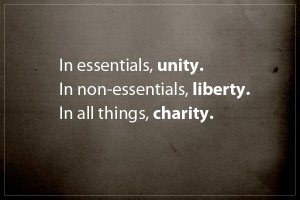
In essentials unity, in non-essentials liberty, in all things charity.
Bible Study
Here’s a bible study and discussion to go along with the series. You may want to use it in your Life Group or City Group.