
Morally ambiguous characters. Gratuitous drunkenness, sex and violence. Throwing a dice to make decisions. Impaling people on spikes. Attempted annihilation of the Jewish race and no reference of God at all. What the heck is the book of Esther doing in the Bible!?
I am glad you asked.
The Absence Of God
The book of Esther is a romantic-style story with a captivating plot. It also contains some delightful reversals, humorous downfalls and plenty of ‘coincidences’. Additionally, it’s not only a historical account of how the Jews were delivered from Haman’s holocaust attempt (2500 years before Hitler’s), it’s also an important theological lesson about the ‘silent sovereignty’ of God or ‘the hiddenness of God.’
Even when he seems absent, even when there are no miracles and acts of power, even when God’s people are in the minority, despised and on the cusp of extinction, he is working in ordinary ways and through ordinary people. His promises stand firm, his purposes prevail, his people persevere. As Jesus would later say about the church, “the gates of hell shall not prevail against her” (Matthew 16:18). There is an indestructibility about God’s people, because God is always working even when we can’t see him.
We’re about to start a six-week series on the book of Esther.  The implications and ramifications for us today are plentiful. I hope you both get caught up in this most magnificent of ancient stories and also captivated by how God can use it to inform you how to live in 21st century Dublin where being a Christian will (a) put you in the minority (b) give you some hostile detractors and (c) place you in morally ambiguous and grey situations where ‘right and wrong’ are not so easy to discern, especially as a Christian in the workplace.
Let me gives you some background to the book and our series.
Esther’s Historical Context
The book of Esther records events that took place between 468-465 during the reign of Xerxes 1, King of Persia; the most powerful empire in the world containing no less than 127 provinces in all, stretching all the way from India to South Sudan (Esther 1:1). This is 100 years after the last of the Jewish people were exiled from Jerusalem into Babylon by King Nebuchadnezzar (586 BC). Babylon was later succeeded by Persia when Cyrus the Great came to power through the Battle of Opis. The Jews are at this point a scattered minority within the empire where there are latent anti-Semitic feelings (Esther 2:10).
Establishing Purim
From a Jewish perspective, and within Jewish history itself, the importance of the book of Esther is to explain and establish a festival called Purim which is still celebrated by Jews today. The last section of the book (chapters 8-9) are all to do with the festival as the Jewish people remember with joy their deliverance from their enemy Haman and their survival as a race. They celebrate it with feasting, joy, giving presents of food to one another and gifts to the poor. It was a festival to remember when:
‘they got relief from their enemies…their sorrow was turned into joy and their mourning into a day of celebration” (Esther 9:21-22 and 27-28).
It wasn’t part of the festivals given in the Mosaic law and was different in flavour and style, but its aim was similar. It falls one month before Passover (the Jewish festival celebrating God’s rescue of the Jews out of Egypt through the red sea). Barry Webb says this:
“When Purim is celebrated, Passover is just around the corner.
“There are two very different kinds of festivals. Purim is noisy, merry and secular in flavour. Passover is calm, meditative and deeply religious. Yet they are linked by a common theme. The passover celebrates the deliverance of the Israelites from slavery in Egypt, Purim their deliverance from annihilation in Persia. Between them they frame almost the entire sweep of Old Testament history, and mark it as a story of deliverance from beginning to end.”

Deliverance, Reversal, Coincidences & Humour
The theme of deliverance and reversal is constant through the book, and most clearly seen in the structure of the book in which it starts with Haman’s exaltation, Vashti as queen and a plot to kill the Jews. It ends with exaltation of Mordecai, Esther as queen and the prospering of the Jews within the empire. The Jews start out powerless and end up empowered. Initially we encounter a policy of anti-Semitism but finally we’re enjoying a festival celebrating Jewishness. The name of the actual festival ‘Purim’ comes from the Jewish word ‘Pur’ which means ‘the lot’ – Haman cast the ‘pur’ to decide on what day to annihilate the Jews, which ends up being their day of celebration.
As has already been mentioned, while God is never referenced in the book, the story as a whole with all its ‘coincidences’ are supposed to lead us to the hidden hand of God working behind the scenes. Webb puts it like this:
“This absence is certainly one of the most striking features of the book. What clearly is present, however, is a whole series of remarkable coincidences which tip the balance of events in favour of the Jews at critical moments: the timely removal of Vashti, creating the opportunity for Esther to move into a position of power, Mordecai’s equally fortuitous overhearing of the conspiratorial conversation of the eunuchs (2:21-22); the king’s insomnia of the night before the proposed execution of Mordecai and his calling for the royal annals (6:1-2); the entry of Haman at the precise moment when the king is wondering how best to reward Mordecai (6:4); and the king’s entry when Haman is compromising himself by falling on Esther’s couch (7:8). All these incidents materially affect the outcome, but none is the result of any strategy on the part of the Jews. Either the Jews have extraordinary good luck, or unseen powers are at work, giving events a particular shape and direction.”
Or more strikingly Tim Keller says it like this:
“When you see one of the ten plagues, you know that’s God! But when King Xerxes gets drunk and starts bragging, you don’t say, “Wow. There’s God at work!” But the book of Esther is trying to tell you, “Don’t make that mistake. God is at work.”
Additionally the actual genre of the book, is either historical romance or a (true) novella. The artistry of the story as discussed above with reversals is marvellous and the way the plot is constructed makes it a story not simply of rescue, but of reversal, of tables turned. And these reversals and the many ironies in the story are there to evoke laughter, hence Purim is a festival of such happy celebration. And the most savage bits of humour are at the expense of Haman, the great enemy of the Jews. So just as God himself laughs at any pretenders to his throne (Psalm 2:1-4), so we too as God’s people must remember we’ll have the last laugh if we stay faithful to God in a hostile world where non-believers hold power and God’s people have to watch their every step, sometimes fearing for their lives. Laughter may the only way to stay sane! Jobes puts it like this:
“The author teaches us to make fun of the very forces that once threatened—and will again threaten—our existence, and thereby makes us recognise their triviality as well as their power. “If I laugh at any mortal thing,” said Byron, “‘tis that I may not weep.” Jews have learned that kind of laughter.

The Main Characters (Questionable Heroes)
The action of the four main characters happens predominantly within the Persian court in the citadel of Susa. And from chapters 1-2 we quickly learn of an opulent, multi-lingual world where the king’s whim is the law and where the law is irreversible (1:19). These four main characters, and even our heroes (Esther and Mordecai) are questionable at times in their decisions and actions.
- King Xerxes – a foolish, rash and extremely wealthy king who, although he has control over 127 provinces, cannot control his wife (queen Vashti) who he orders to be killed for insubordination. Deceived by Haman he orders the killing of the Jews without realising what he is doing.
- Mordecai – Uncle to Esther who raised Esther after she was orphaned. He lives outside of the palace. A wise and courageous man (on the whole) who becomes second in charge in the kingdom. He is a Benjamite and descendant of Kish (the father of King Saul).
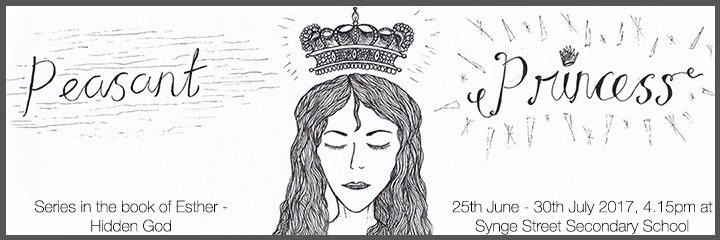
- Esther – The Peasant Princess who through winning a beauty pageant and outdoing her 1000 peers goes from rags to riches. Initially she hides her Jewish identity on the advice of her uncle Mordecai but later acts in courage and reveals it to the king.
- Haman – he is an Agagite (one of the Amalekite clans) and is senior advisor to Xerxes at the start of the story. He is hugely proud and insecure, with a lust for power and glory. Despite plotting to kill the Jews (to spite Mordecai’s unwilling to bow to him) he ends up being impaled on the same spike/gallows he had made for Mordecai.

A century before this story, Jeremiah had written to the exiles telling them to ‘seek the peace and prosperity of the city’ to which they were called (Jeremiah 29:24-27). Not to capitulate to the culture, nor retreat, but to co-operate, where possible for the good of the city. Years later, Mordecai and Esther are trying to follow this advice and at times it’s hard to discern whether their actions are commendable or questionable. And they therefore do not give us the same transparent goodness as a Daniel (in Babylon) or Joseph (in Egypt). Heroes they may be but they are at best heroes of questionable morality and orthodoxy.
But isn’t that an encouragement for us who so often think we may have made the wrong decision in a grey area, or worse know we have made a wrong decision in a black-and-white area? God can still use us in the positions we find ourselves in, even if we got there with dubious tactics and motives. Karen Jobes puts it like this:
“Perhaps, like Esther, you have been brought to this moment in your life by circumstances over which you had no control, combined with flawed decisions you made along the way. Perhaps instead of living for God, you have so concealed your Christian faith that no one would even identify you as a Christian. Then suddenly you find yourself facing calamity. Regardless of the straits you find yourself in, turn to the Lord. . . . his purposes are greater than yours.”
6 Week Series (25th June – 30th July)
Here is how the series will go:
- 25th June: Celebrating Purim – a kid-friendly overview to Esther as part of the Summer Party. There will be actions, hissing, booing, ooohs, aaahhs, cheering, a pass the parcel, presents, food and we’ll (pretend) to get Eben on some gallows!
- 2nd July: Esther 1-2 – The Silent Sovereignty of God
- 9th July: Esther 3-4 – Esther’s Courage
- 16th July: Esther 5-6 – Haman’s Downfall
- 23rd July: Esther 7-8 – The King’s Edict
- 30th July: Esther 9-10 – Mordecai’s Exaltation
Additionally, Danny will be running a ‘Going Deeper’ seminar on the whole book on Sunday 2nd July after the service, 6.15-7.45pm.
I hope you can join us, 4.15pm each Sunday at Synge Street Secondary School in Portobello.
Helpful Articles & Resources
If you want to go further with your own study of Esther, here are some resources for you to read/watch/listen to.
- An illustrated video overview to the book Esther (by The Bible Project)
- Esther and the Silent Sovereignty of God (TGC)
- For such a time as this (TGC)
- When to go public with faith at work (TGC)
- NIV Esther Commentary by Karen Jobs
- Five Festal Garments by Barry Webb
- 8 free sermons (TGC)