
Have you ever tried to catch a bubble? The moment you catch it, it’s gone! That experience, says Solomon in the book of Ecclesiastes, is what life feels like. For the most part life can feel hard, complicated, unfair and exhausting, and just when you think you’re getting some satisfaction and control…it’s gone!
We feel we should be able to control life and find peace and stability, meaning and clarity within it, yet these things elude us. And even if we are able to grasp something that seems to last a bit longer, death will one day come and sweep me and all my achievements away. So what does a man gain/profit from all his labour? It all feels so meaningless!
Welcome to the book of Ecclesiasties which opens by saying:
“Meaningless! Meaningless!”
says the Teacher.
“Utterly meaningless!
Everything is meaningless.”
As one person put it:
“Ecclesiastes is perhaps the most enigmatic book in the Old Testament. Like the desert sphinx, it will tease us with questions, yields its secrets only begrudgingly, and will not allow us the luxury of easy answers. In other words, it is thoroughly irritating but at the same time almost mesmeric, in it’s appeal. It draws us towards it by mirroring the perplexity we all feel as we grapple with life.”
Vapour of Vapours

The Hebrew word hebel (used 38 times in the book) which in modern versions is translated ‘vanity’ or ‘absurd’ or ‘meaningless’ literally means ‘vapour’ or ‘mist.’ So what Solomon says above is actually:
“Vapour of vapours. All is vapour”
Outside Ecclesiastes the word is translated as breath (Psalm 62:9, 94:1, 144:4) or vapour (Proverbs 21:6). Peter Leithart says:
“When the word is used metaphorically, it emphasises the ephemerality and elusiveness of human existence. Human life is hebel because it is impermanent, because we change and ultimately die.
“When Solomon describes “everything” as vapour, he is … highlighting the elusiveness of the world, which slips through our fingers and escapes all our efforts to manage it. He is pointing to the brevity of life, and everything in it, which dissolves as quickly as the mist in the morning.”
As the New Testament writer James says:
“Why, you do not even know what will happen tomorrow. What is your life? You are a mist that appears for a little while and then vanishes.” (4:14)
So life is a futile pursuit of something we never catch…and then we die! What a joyful message! Solomon himself will try to find permanence and meaning through many ways – work, gardening, construction, wisdom, sex, pleasure etc – but in the end, he says all our attempts are just “a chasing after the wind” (Ecc 2:11), or more accurately a futile attempt to “shepherd the wind.” The image is less to do with futile pursuit (though that is certainly the case!) but expresses our lack of control over the world and our own lives. As Leithart** says:
“We can no more bring the world under our complete control than we can guide the wind into a paddock for the night. We can no more give permanent form to the world than we can sculpt the evening breeze into solid shapes.
“What profit is there in all our striving? What profit is there in wealth? What profit is there in the pursuit of knowledge and wisdom?” Solomon’s answer: “vapour of vapours, all is vapour.”
All our efforts to try and make life meaningful to us, in the end, never enable us to find the satisfaction and control we want. Even if we get them temporarily they will eventually escape us, and after that we die.
Under the Sun

Whilst the book of Ecclesiastes is very realistic about life, it’s describing the life under the curse of God (Genesis 3) where the whole creation is groaning (Romans 8:19-24), all is not lost. Why? Solomon repeatedly uses the phrase ‘under the sun’ or ‘under heaven’ which gives all that he is talking to a reference point. Life under the sun can be elusive, absurd, pointless and meaningless. Everything that we can count as ‘profit’ does not seem to last or bring us the control we hope for.
But there is more to know than life under the sun, and this gives our lives meaning and purpose, direction and accountability. One day, as Paul says “creation will be liberated from it’s bondage to decay and brought into the glorious freedom of the Sons of God” (Romans 8:21).
Leithart says:
“In scripture, the sun is a marker of time (Gen 1:14) and the phrase “under the sun” is more a temporal designation than a spatial one. It refers to a now rather than a there…under the sun, during this time, we are surrounded by diffusion, difference, death and decay…under the sun, our projects slip from our fingers like mist…all is vapour – our lives our books, our words, our projects. All is so much futile shepherding wind.
Unlike most Postmoderns, however, Solomon does not believe that the world “under the sin” is the only world there is. One of things Solomon says he knows that God will bring all wickedness to judgement (3:16-17)…
In knowing that God will judge, Solomon knows, there is a final word, a word that closes out the time under the sun and begins the time after the time under the sun…and this omega-word is, christians confess, also the alpha-word, the Word who was from beginning, the living Word, who is with God who is God, the Living Word.
Eat, Drink & Rejoice
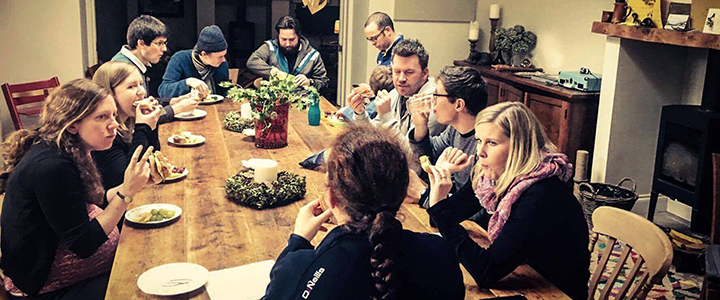
Throughout the book, among all the perplexities and frustrations, in a world that is elusive and out of our control, Solomon on a number of occasions tells us to eat, drink and enjoy our work. For example, 2:24-25 says:
“A person can do nothing better than to eat and drink and find satisfaction in their own toil. This too, I see, is from the hand of God, for without him, who can eat or find enjoyment?”
Why is this? Well alongside knowing that there is more to life than what we see around us, and the meaning and stability that we long for is found in God, who is not under the Sun, we can also find meaning as we learn not to strive to make a profit, but give thanks for what we have. Instead of trying to earn something that we can’t keep (because it will escape our grasp) we should learn to give thanks for what we have been given. Webb says:
“The possibility of enjoyment returns, significantly, only when the quest for profit is given up altogether (2:22-23), and replaced by the notion of gift. Opportunities to eat, drink and find satisfaction in one’s work, when they come, are not human achievements but divine gifts and are to be enjoyed as such. They are only palliatives, to be sure, for they too are hebel, and will slip from our grip like everything else – but that is no reason to reject them.”
And so Liethart finishes his outstanding book by recommending a stance for us to take as we live life in knowledge that everything is hebel.
“The stance is simple to describe: it is the stance Solomon recommends in Ecclesiastes, a stance of faith, joy and worship. In the midst of postmodern mist and vapour, Christians are called to be Christians.
Faith first…the world is built to force us to live by faith not by sight. “Vapour” pictures the world as impossible to control. But vapour is also a veil, a screen…that its hiding something, and Solomon is suggesting that the vapour of the world screens us from God himself, who for the time being, “under the sun,” modestly remains behind the veil of the vaporous world…we don’t yet see God putting everything right. We don’t see the sovereign hand of poetic justice. Innocents die, sages are ignored, moral pygmies rule the airwaves and the movie screens and many nations. That’s what it’s like to live in a world of vapour…Solomon directs our hope to a God who will emerge from the mist to judge the world in righteousness.
And faith means joy…Solomon shows us a way to real joy: the realisation that we’re not in charge, we never were in charge, and we don’t need to be in charge, because that’s Someone Else’s job. For Solomon, the life of faith is a life of joy because faith liberates us from the burden of taking care of creation that was never ours to begin with. Like a later sage, Solomon encourages us to be as children, and he opens the gate of the playground, where we eat and drink under the loving gaze of our Father
And worship…Ecclesiastes is not just about the mist; it’s about a table in the mist…In worship we participate in the age to come – the world after the world under the sun – and in this moment of encounter with the God hidden in the mist, we glimpse something of a pattern in the vapour.
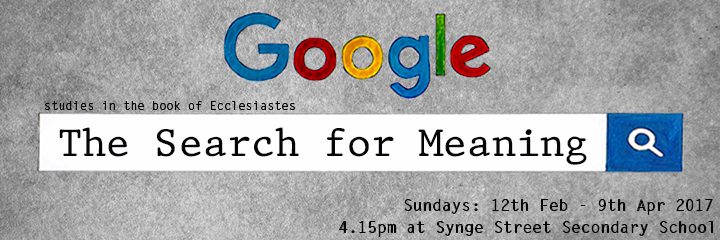
Our Series – The Search For Meaning
The book of Ecclesiastes speaks so powerfully to modern people in Dublin. On the one hand many people know the trials and injustices that Ecclesiastes talks about, but they don’t have the resources or faith in God and the hope of heaven to cope. But there are also many in Dublin whose life ‘on the surface’ seems very easy and pleasant, and yet they too know how elusive and pointless life can be. They haven’t learnt to enjoy what they have as a gift from God and ‘feast at his table.’
So as a Christian community seeking the good of the city, we must learn this stance of faith, joy and worship. We must mourn with those who mourn and dance with those who dance. We must explain how “God has made everything beautiful in it’s time, but he has also set eternity in the hearts of men” (Ecclesiastes 3:11). And we must become a bright light, shining in a vaporous world, helping people come to know the God who is so often veiled by the mist.
So join us for our nine part series as we look to this ancient book to find wisdom for modern life.
- The search for Meaning (Ecclesiastes 1-2)
- A time for everything (Ecclesiastes 3)
- Companionship in an unjust world (Ecclesiastes 4)
- Approaching God (Ecclesiastes 5:1-7)
- The pursuit of wealth (Ecclesiastes 5:8 – 6:12)
- Surviving in an unjust world (Ecclesiastes 7-8, 10)
- The pursuit of death (Ecclesiastes 9)
- Just Do It (Ecclesiastes 11:1-6)
- Remember your creator (Ecclesiastes 11:7-12:14)
The series starts on Sunday 12th February, at 4.15pm at Synge Street Secondary School. I hope you can join us.
—
*Barry Webb – Five Festal Garments – Christian Reflections on the Song of Songs, Ruth, Lamentations, Ecclesiastes and Esther.
**Peter Leithart – Solomon among the Postmoderns
We’ll also use Derek Kidner’s (A time to mourn and a time to dance) and Michael Eaton’s (Ecclesiastes) commentaries to help us through the series.