
From Sunday 11th October to 29th November we will be studying Daniel chapters 1-7 as a church, under the title “Allegiance: To Whom Will You Bow?” Before we get into the outline of the series let me put things in context, both ancient (Daniel’s time) and modern (our time).
Daniel is an inspiration to me for three reasons and I think he helps us with two big issues that face us today.
(1) His trust in God in the face of adversity
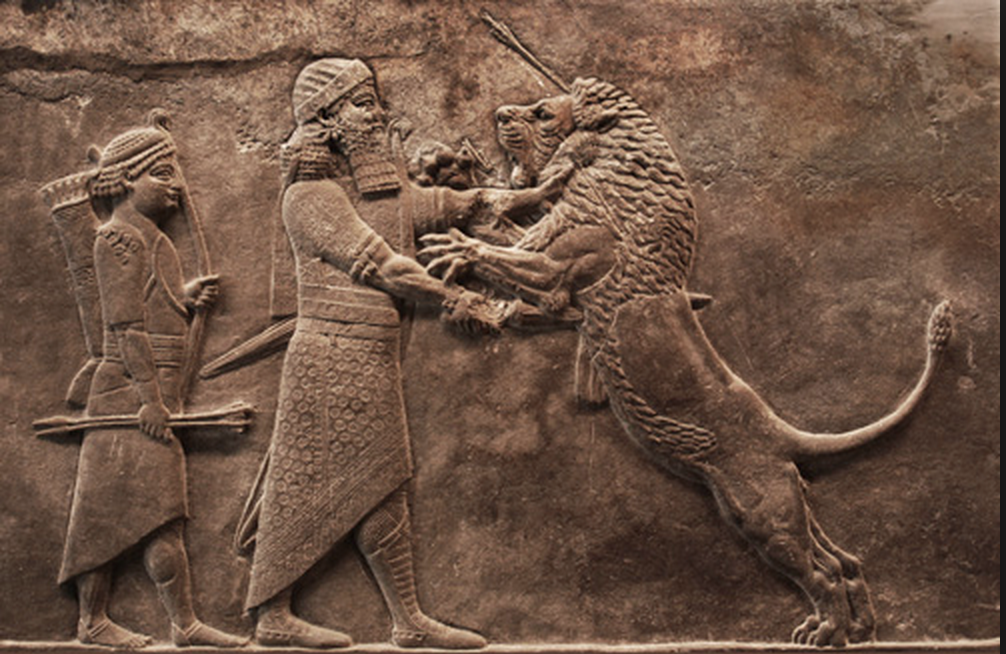
Palace Relief Depicting Ashburnanipal killing a lion
Daniel was only a teenager when he was transported from his home city Jerusalem and into exile in Babylon. He would have witnessed his family and friends being killed, his city being destroyed, his temple ransacked and his God ridiculed. He himself was spared because King Nebuchadnezzar wanted the brightest Hebrews to be part of his re-education program and help with the spread of Babylonian culture back into the places he had conquered. It would be a bit like ISIS conquering Dublin and taking the TCD students back to Iraq to teach them Sharia Law (incidentally, the old city of Babylon is just outside Baghdad).
It’s remarkable how flexible, adaptable, courageous, wise and discerning Daniel is amidst such turmoil, suffering and transition. And as we read the book of Daniel we’ll see that he had complete trust that God was in charge of all that was going on; nothing happened outside of his knowledge; and he was weaving it all together to bring about a great purpose. This is seen from chapter 1:2 onwards where it says “And the Lord delivered Jehoiakim king of Judah into his [King Nebuchadnezzar’s] hand.” Whilst an evil man was performing evil deeds, he was still being used to carry out God’s plan (something we see many times through scripture – for example the story of Joseph in Genesis 50:20 and the story of the cross in Acts 2:22-23). We will reflect on the tension between God’s Sovereignty and human responsibility throughout the series, but Daniel never doubted that God had left him alone, nor that his hand was still at work in such tragedy.
**So the question for us as we approach the book of Daniel is – how can we learn to trust God when everything goes wrong? How can we remain adaptable, flexible and courageous?
John Lennox raises another important point in looking at Daniel’s trust. He says:
We shall never understand the stability and purposefulness of Daniel’s life until we grasp the attitude of mind that characterised it. Although he lived in this world, he did not live for it. It was in another world that he invested his life, and it is there that he now enjoys his inheritance. (pg24)
(2) His personal devotion in all seasons
In chapter 1 Daniel doesn’t want to “defile himself” with the king’s food. In chapter 2 he holds a prayer meeting so they can interpret a dream; in chapter 5 we find him praying three times a day; in chapter 9 we find him meditating on the scriptures (the letter from Jeremiah); and in chapter 10 we find him fasting from meat and wine for three weeks. From chapter 1 through to chapter 12 we move through 70 years of his life (605BC to 535BC), four different rulers (Nebuchadnezzar, Belshazzar, Darius and Cyrus) and two empires (Babylon and Persian); and yet through each era he is still praying, still reading scripture, still fasting and still making decisions in day-to-day life to keep God front and centre. And I am sure there were lots more things that he did that we have not been told. Most of it is unseen, which is the whole point, because he was living for the audience of one. Sometimes he is being intensely persecuted; sometimes he is given a status and power second only to the emperor; sometimes he is left in obscurity and almost forgotten. Yet throughout, his relationship with God remained intact and his passion red hot.
**So the question for us as we approach the book of Daniel is – how can we learn to keep ‘on fire’ for God through different seasons of life and as we face different highs and lows.
(3) His courage and wisdom in the public eye
 Daniel lived much of his life right in the heart of power. He came as a talented Hebrew teenager and would become the second most powerful man in the greatest empire of the world at the time. And in the public eye he managed to be as courageous and truthful as he was wise and tactful. He was, to use Jesus’ expression “as wise as a serpent and as gentle as a dove”. He didn’t compromise what he believed (to the point of being thrown to the lions) and yet he wasn’t bashful or arrogant or un-necessarily insensitive. He modeled perfectly that summary verse of what evangelism should look like, from 1 Peter 3:15:
But in your hearts revere Christ as Lord. Always be prepared to give an answer to everyone who asks you to give the reason for the hope that you have. But do this with gentleness and respect,
Notice the three stages in this verse
- He feared the Lord – in his heart he made a decision to honour God above all else
- He was prepared to give an answer – to anyone and everyone, explaining his hope and his good news.
- He was gentle and respectful – listening well, winning favour with the officials and the public and looking for as much common ground as possible
As John Lennox insightfully says, “he protested as a participant”. For example, when deciding not to defile himself with the king’s food (in chapter 1), which was an act of protest and could have been seen as an act of rebellion, he did this within the context of having his name changed and fully engaging in the language and literature studies Nebucahdnezzar had set them. Lennox highlights this tension well when he says:
We should take careful note, however, that Daniel did not protest against the education in the University of Babylon as such. He clearly devoted himself to it, and we can well imagine that he enjoyed his university course. He and his friends put such energy into the learning of the languages, literature, philosophy, science, economics, history and so on, that they were star pupils and ended up with the top distinctions, far ahead of the rest. Daniel did not protest as an observer outside the system: he protested as a participant.
**So the question for us as we approach the book of Daniel is – how can we use our positions in society to do good and witness to God, but do it with tact and love? How can we use positions in our colleges, workplaces, schools, communities to be salt and light for Christ?
Issue 1 – Daniel and Dawkins
John Lennox, whose book Against the Flow – The Inspiration of Daniel in an Age of Relativism will be a helpful resource throughout the series, is an Oxford Professor of Mathematics and is very famous for debating with Richard Dawkins and writing many good books to refute what Dawkins and his companions are saying. So much of what Lennox is doing is trying to help us live out our faith in a world that, because of those like Dawkins, is becoming more and more hostile to the Christian faith. Lennox says this in chapter 1 with regards to the New Atheism:
The story of Daniel and his friends is a clarion call to our generation to be courageous; not to lose our nerve and allow the expression of our faith to be diluted and squeezed out of the public space and thus rendered spineless and ineffective. Their story will also tell us that this objective is not likely to be achieved without cost. As political correctness stifles Christian witness, atheism seems to become more and more vocal in the public arena. Richard Dawkins in The God Delusion, Sam Harris in his Letter to a Christian Nation, Christopher Hitchens in God is Not Great, and Michel Onfray in Atheist Manifesto have been rallying the troops behind them by heralding the dangers of religion and the desirability of eliminating it. In order to do this, these so-called New Atheists harness the immense cultural power of science. At a conference at the Salk Institute of Biological Sciences in La Jolla, California, in November 1994, Nobel Laureate Steven Weinberg suggested ominously that the best contribution that scientists could make in this generation was the complete elimination of religion.
Weinberg and others portray atheism as the only intellectually respectable worldview. Intolerance of religion and growing disrespect of those with religious convictions are central features of their increasingly shrill onslaught. Indeed, their constant repetition of ragged and philosophically superficial arguments leads one to suspect that their great emperor of atheism is beginning to shiver through lack of clothes.
If Daniel and his three friends were with us today I have no doubt that they would be in the vanguard of the public debate, leading the counter-charge against the self-styled “four horsemen of the New Atheism”, as Dawkins and his allies Dennett, Harris, and Hitchens call themselves. In this book we shall try to learn something about what it was that gave that ancient foursome the strength and conviction to be prepared, often at great risk, to swim against the flow in their society and give unequivocal, courageous public expression to what they believed. This will surely strengthen our resolve, not only to put our heads above the parapet, but also to make sure in advance that our minds and hearts are prepared—that our helmets are securely on—so that we do not get blown away in the first salvo.
Issue 2 – Exilic Discipleship
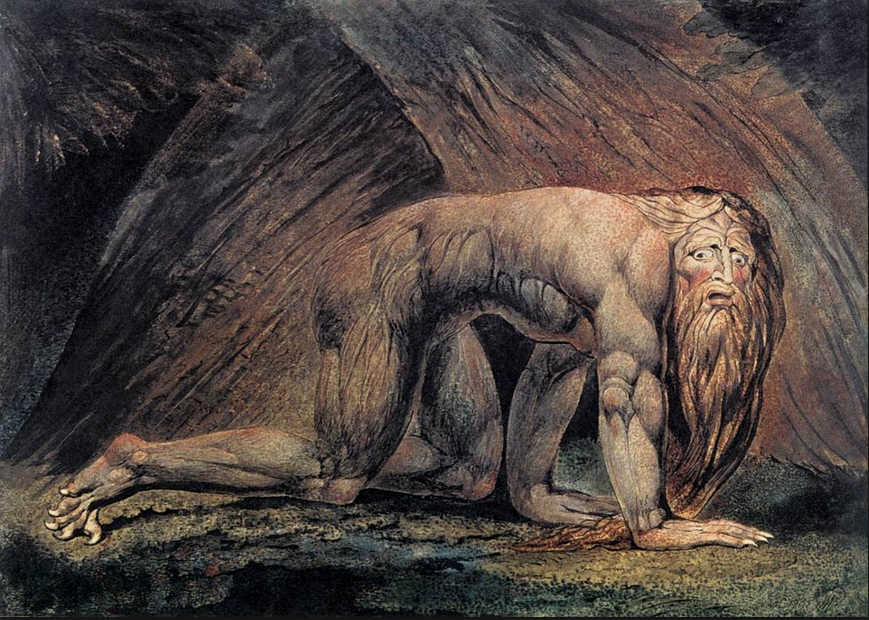
Nebuchadnezzar: William Blake, 1795
I was introduced to this phrase just last week. The idea is simple and powerful and it applies to both Daniel and modern Dublin. Exilic Discipleship is learning how to live for God when in Babylon, as opposed to living for God in Jerusalem. In Jerusalem everyone goes to the temple to worship God, everyone reads the scriptures, prays, fasts and has a general set of values that fit with God’s will. So most of ‘Jerusalem discipleship’ is based on gathering God’s people together for worship and helping them not become legalistic and rule-based but keeping a tender and humble heart (think of Jesus’ treatment of the Pharisees). And that is good and important for Jerusalem.
However when the prevailing culture no longer believes in your God (and may think you crazy for believing in God); and they certainly don’t read the scriptures, pray or agree with your ethical values, then our discipleship must change. Now it is not so much about gathering God’s people together to keep our hearts soft, it is about preparing God’s people for action in a world that will reject them. How can we shine brightly? How can we be a part of the culture without capitulating to culture? How can we different from the culture without becoming irrelevant in the culture?
The last 30 years has seen a huge transition in Dublin; we have moved from being in Jerusalem (everyone goes to church) to being in Babylon (almost no-one goes to church). We have moved from traditional conservative ethics around sexuality, family and life to modern liberal ethics on all these things. However we have also seen that this transition has not brought greater happiness, contentment and stability – if anything it’s brought the opposite. My hope is that as we study the book of Daniel we’ll be equipped to live as he lived and make the difference that he made. We’ll learn to live with the same joy and strength that he did.
Series Outline
Chapter 1 – Taking a stance early. This chapter is a must read for all Christian Freshers as they navigate college life. Daniel works out the areas of culture he can go along with and works out the areas he must take a stand. As Lennox says “that initial resolve developed into the established habit of a lifetime.”
Chapter 2 – Who rules the world? This chapter is all about the king’s dream of a statue with a gold head, silver chest, bronze belly, iron legs and clay feet. The statue represents different empires that will come (and go) over the next 1000 years and how another kingdom will come, initially as a little stone but will grow to be a mountain to fill the whole earth. The stone would be Christ and the mountain would be his ever-extending and never-ending kingdom that will outlast all the other kingdoms. If we can learn that God really is in charge of the world, we’ll have a courage like no-one else on earth.
Chapter 3 – Bow or burn. This time the statue is not in a dream but in real life, and Daniel and his friends must bow to the statue to show allegiance to the king. But they will not, that would be to break the first commandment and betray their God. They are thrown into the fiery furnace for this act of defiance, yet God protects them and comes down to join them as the ‘fourth man’ walking amongst them. This chapter also contains what I think is the greatest statement of faith found anywhere in the bible – have a read of Daniel 3:16-18
Chapter 4 – Humbling the proud. This chapter is King Nebuchadnezzar’s testimony and how God humbled him. His pride and arrogance were the reason God brought him low, but when he was humbled (and ate grass like cattle), he repented, confessed his sin and was restored. He ends by saying “Now I, Nebuchadnezzar, praise and exalt and glorify the King of heaven, because everything he does is right and all his ways are just. And those who walk in pride he is able to humble.”
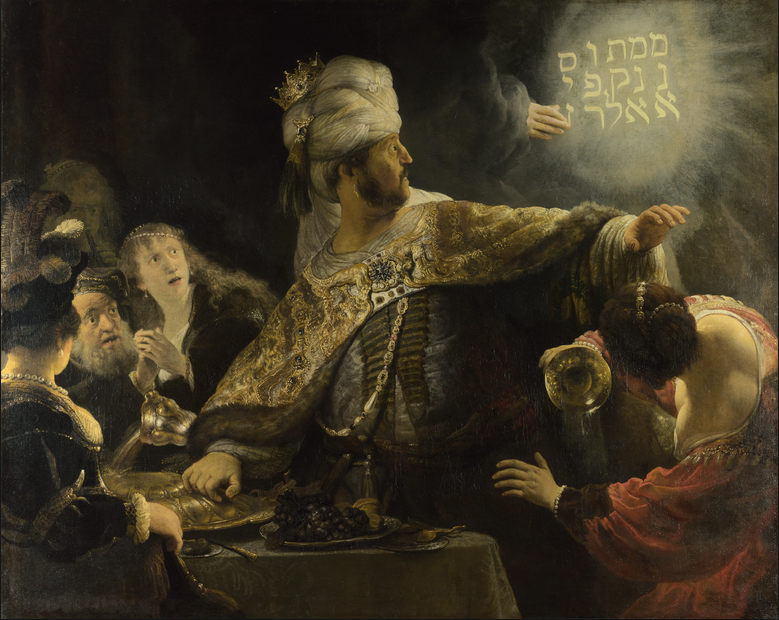
Chapter 5 – The writing on the wall. We’re now with Nebuchadnezzar’s kid Belshazzar who doesn’t seem to learn any of the lessons his father learned. He was arrogant and defied God too; he thought he was invincible. So God taught him a rather scary lesson by sending a hand to write on the wall telling him his time and his kingdom had come. Then Darius the Mede took over the kingdom.
Chapter 6 – Facing the lions. This is every child’s favourite story and yet it remains as relevant today as it ever was. Will we compromise when suffering comes? Will we stand for Christ and be persecuted and killed? This is no child’s story; this is something that penetrates our deepest commitments of our hearts.
Chapter 7 – The Son of Man. One of Jesus’ favourite expressions for himself was ‘The Son of Man’ – has authority to forgive sins (Mark 2:10), is Lord of the Sabbath (Mark 2:28), will be rejected and killed (Mark 8:31) and so on and so forth. When Jesus takes this title upon himself he is quoting Daniel 7 where the Son of Man approaches the Ancient of Days who is judging all history and all people and it says “He [the son of man] was given authority, glory and sovereign power; all nations and peoples of every language worshiped him. His dominion is an everlasting dominion that will not pass away, and his kingdom is one that will never be destroyed.” Ultimately the book of Daniel points forward to Jesus and his kingdom and calls us to live our lives now knowing where eternity is heading.
I am excited; I hope you are and I hope you’ll join us.