
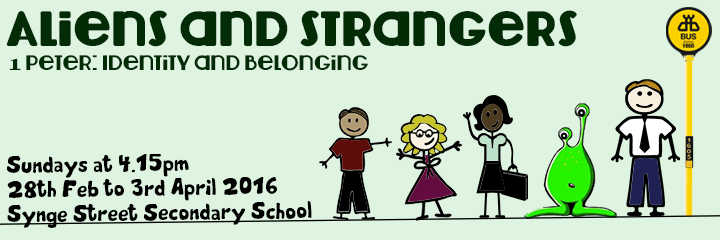
On Sunday 28th February 2016 we kicked off this ‘Aliens and Strangers‘ series with a launch party in our new venue, Synge Street Secondary School. You can see photos from the event on our Facebook page.
We’ll be continuing the series till Easter Sunday and this blog post outlines some of the themes we’ll explore.
Being the Odd One Out
 We have all known the feeling of being the odd one out. It’s a feeling we all hate and try desperately to avoid. Many of us have tough memories of not fitting in or not being in with the ‘cool gang’ as children, or being the last one picked in the playground. However this isn’t something that we only experience when we’re children and teenagers; it’s something that continues throughout our whole lives. We have this insatiable desire to be accepted and to belong. We want to be part of the inner circle. We don’t want to stand out; we don’t want to be left out. We don’t want to be different. For those who choose to be different there is great pressure to conform – to think and act like everyone else does. And even if you do stand out you’ll often be on the receiving end of Tall Poppy Syndrome: people will criticise, maybe vilify you. It’s not easy being in the minority. It’s not easy to be an alien and a stranger.
So in this service we’ll think more about the issue of belonging – where do I belong?
Who am I?
 Linked to the question of belonging is the equally important question of identity. Who I decide to be will ultimately define where I belong. Or maybe where I decide to belong will ultimately define who I am. Belonging and identity are inextricably linked. Traditional cultures had no problem answering the question of identity as your identity was a given, it was handed down to you because of your family, gender, background and social class. Whilst this way of defining identity had its problems, far less people had an identity crisis compared with today.
Modern (and post-modern) culture finds it hard to answer the question “Who am I?” Everything has become fluid. I no longer accept my identity that is being handed down to me but I create my identity. I am a blank canvas and I get to paint whatever I want onto it. I am free and I can choose both my online and offline identity. However this freedom has brought not stability but a very unstable sense of self. We’re not sure who we are any longer. In order to try and find stability, we have come up with many different ways to define our identity. Here are six common examples:
- I am how I look
- I am what I eat
- I am what I wear
- I am what I buy
- I am what I do
- I am who I am with
Of course, our identity changes as quickly as the culture around us changes, since identity and belonging cannot be separated. So over time our identity changes again and again.
A Personal and Global Crisis
 The crisis around identity and belonging is not just an individual experience anymore, it’s a global crisis. I can think of numerous people I know who feel like aliens and strangers. They don’t feel they belong. They don’t find it easy to understand the city or the culture or the language. I also know people whose parents are from different backgrounds, who grew up in 2-3 different countries and only recently have arrived in Dublin. They are not sure where their home is. They are not sure of their identity.
If we look at the global scene in the last year: our newspapers, websites and TVs have been filled with pictures, statistics and stories of people fleeing from their homeland to find refuge in a foreign land. Many countries (including Ireland) have been confronted with the challenge of welcoming, accommodating, caring for and integrating people who are looking for a new home.
It’s into this crisis of belonging and identity that we need to re-read the first letter from the Apostle Peter, written at the end of the first century, when the Roman Empire made it very hard for certain people (including Christians) to belong.
1 Peter and 1st Century Rome
 The churches that Peter was writing to were coming under great pressure. It was not ‘cool’ or easy to be a Christian. They were in the minority. They were thought of as odd or weird. Whilst there was some violent persecution that Christians faced at this time (under the Emperor Nero), it doesn’t seem to be organised state opposition but rather social pressure that the Christians faced. So when Peter writes his letter to encourage the churches he coins the phrase “aliens and strangers” – see how he starts the book:
Peter, an apostle of Jesus Christ, To God’s elect, aliens scattered throughout the provinces of Pontus, Galatia, Cappadocia, Asia and Bithynia, who have been chosen according to the foreknowledge of God the Father (1 Peter 1:1-2)
Later he says this:
Since you call on a Father who judges each person’s work impartially, live out your time as foreigners here in reverent fear (1:17)
Dear friends, I urge you, as aliens and strangers, to abstain from sinful desires, which wage war against your soul (2:11)
These Christians were resident aliens. They lived somewhere they didn’t belong, like living in a foreign land. What is Peter’s encouragement to them? This is what we’ll be looking at over the five week series – he reminds them again and again that they are chosen and special to God. That they do belong…they belong to God’s people. They do have an identity…they are children of God. For example he says:
You are a chosen people, a royal priesthood, a holy nation, God’s special possession… Once you were not a people, but now you are the people of God; once you had not received mercy, but now you have received mercy (2:9-10).
To be God’s special possession gives you an identity and belonging which will not change according to the current moods of culture. It will give you a confidence and security to stand out when you need to. It will give you an assurance that despite people rejecting you, the God of the universe accepts you.
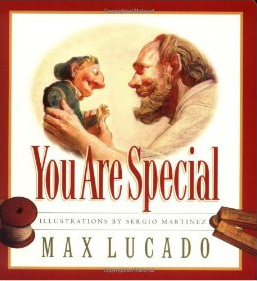 There is a children’s book that I regularly read to my kids, but deep down I know I need to regularly read it to myself. It’s called You Are Special by Max Lucado, and he brilliantly describes the power of knowing that you are God’s special possession.
So as we think about what it means to be ‘church’ in 21st Century Dublin where more and more people are leaving church, we are called to be resident aliens – to live right in the thick of things, with people who may disagree with us, making a positive difference in Dublin, but resisting the pressure to conform. Os Guinness (yes of the Guinness dynasty!) puts it well when he says:
We are to live in the world in a stance of both yes and no, affirmation and antithesis, of being against the world and for the world
1 Peter – Aliens & Strangers
Here is the outline of our five week series
- 1 Peter 1 – Aliens & Strangers (Launch Event, 28th February)
- 1 Peter 2 – Suffering with Grace
- 1 Peter 3 – Ready to Give an Answer
- 1 Peter 4 – Provocative People
- 1 Peter 1 – Resurrection Hope (Easter Day, 27th March)
- 1 Peter 5 – Steadfastness
I hope you can join us on Sundays, 4.15pm in Synge Street Secondary School, and in the Bleeding Horse pub afterwards (we have up the stairs and to the left reserved). We hope this series will be thought provoking for all of us!