
This blog consists of two parts: the first shares the perspective of Margaret, a lecturer at a college in Dublin; the second shares the perspective of Mihai, who works in the advertising industry. Although Margaret and Mihai come from different cultural and professional contexts, their experiences of living alone in lockdown provide valuable insight (regardless of whether we’re living with family, housemates, or are currently exempt from COVID restrictions!).
Margaret’s story
As someone who has chosen to live alone for almost 10 years, many aspects of my life have not changed during lockdown. I still bike into my office at UCD everyday (to make use of the free heating and fast internet!). My family lives abroad, so we are used to communicating via video calls and not meeting each other for long stretches of time. I still meet my social bubble once in a while and go for walks with different people when possible.
Some parts of my life are better. As an introvert, I’ve appreciated the fact that social activities have slowed down and there is less pressure to be doing something every weekend. I’ve enjoyed having the extra time to myself, which I’ve mostly spent reading, trying out new recipes, and finally starting on various exercise regimes that I’d always put off (and yes, I finally succumbed to getting Netflix!). While there have been restrictions on many aspects of life, the lack of choice can, on the other hand, be freeing. Rather than try to optimise every decision, I can make do within the confines of what is possible and free up mental resources for other decisions.

Most of the challenges of lockdown relate to my work environment. I miss the ability to chat with colleagues and co-authors near and far, who would have been just a door’s knock away or who I would have caught up with at research conferences. It’s great to be able to talk via Zoom, but it can feel quite rigid: each meeting has a specific purpose, and there is no possibility of wandering off afterwards for a coffee and chat about other topics.
I miss the interaction with my students and just being able to see their faces to gauge understanding. We lecturers talk about ‘Zoom doom’: when none of our students on Zoom turn on the camera, even if we desperately ask (for the students reading this: your lecturer will LOVE you if you turn your camera on in your Zoom class!).
In face-to-face social gatherings, there is the expectation to be fully present, which is not there on Zoom. Someone on Twitter captured this perfectly:
Zoom has conditioned me to believe that if I don’t like an event or meeting, I can just leave—immediately and without a word to anyone. This will be hard to unlearn.
Less trivially, I’m aware of the danger of egoism. I realise that I essentially haven’t had to think about anyone other than myself this past year. I am lucky that I’ve been spared the worry about parents getting COVID-19, given that they are safe in Australia. I haven’t had to struggle with home-schooling or childcare, as many colleagues have had to do. I haven’t had to deal with spending more-than-ideal time with housemates working from home. I’ve noticed how easy it can be to become self-absorbed—that my needs and problems occupy all my thoughts—having little concern for anything, or anyone, else; and to turn to work as a source of my identity. I sense that through this period God has been challenging me to re-prioritise His kingdom above my selfish ambitions and other idols (Jonah 2:8), re-surrender my heart to Him (Matthew 6:24-25), and remember my identity in Christ (Colossians 3:1-4). These are things I constantly need to remind myself of each day.

Perhaps the hardest thing for me in this pandemic, if we measure it by what I *really really* want to do but potentially cannot, is the limitation to travel. In particular, right now I am still clinging to the hope that I can go on a research visit to another country next month, which for various reasons is not possible to delay past the summer. Such an opportunity doesn’t come by often. It would be amazing for me career-wise, and a lot of fun just to travel again and to meet my co-authors. Before 2020, it would have been straightforward to go. Just now, it’s looking more and more unlikely—so many things (case numbers, quarantine rules, lockdown restrictions in the destination country…) have to line up perfectly for such a trip to happen.
I think we’re all familiar by now with the verses from James 4:13-15, a reminder to hold loosely to plans. And it had been easy for me to think it didn’t apply to me since up to this point I hadn’t had to give up anything (or at least nothing I especially valued). But these days it has been difficult to keep praying “Your will, and nothing less” and mean it. However, I am often reminded of the story of the Israelites who wanted a king so badly, despite warnings from God, so that in the end God gave them King Saul—with disastrous consequences. So I also pray to God: don’t let me want this trip so badly, above You, that You let me have it.
As I wait on God to reveal His will, I know that I would potentially be disappointed should His answer be a ‘no’. I hold on to His promise that He is a good Father who not only will provide everything I need to survive (Matthew 6:32-33), but also to give me everything I need for my enjoyment (1 Timothy 6:17)—even if I don’t end up getting my way.
Mihai’s story
It’s very late, so I’m in a hurry to not be late for work. I try to take the elevator to be quicker, but it’s packed, so I take the stairs to my desk. In the office building, there are 1500 people. Usually, there’s a lot of chaos and agitation: a lot of people talk at the same time and it is hard to concentrate. I’m one of them… I talk a lot. I think I disrupt my colleagues a lot of times, but they are too polite to tell me. Sometimes I like to be the one who makes the atmosphere, who stops the seriousness in the work process. I want to work and smile at the same time. I work in the advertising industry. For me, the creative process is in two opposite places: in a busy and loud place, and in an alone and quiet place. The busy and loud place inspires me, recharges me; it is the place where I laugh, where I meet emotions and feelings. The quiet place is where I dream and I create. At work, sometimes I used my headphones to listen to some music and to find my quiet place in a busy environment.
I had a normal day. But at 5pm, my manager came to us and said that today, everyone should take our work materials home. He said that for a few days, the team would work from home.
—16 March 2020
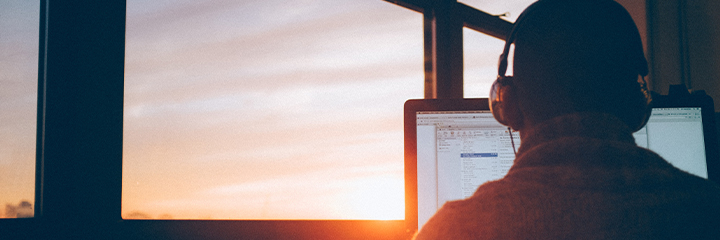
From an office building with a lot of people, I’m now in my 25m2 studio, alone, without any dreams. All of my family is living abroad. For the first three weeks, I was under shock. I wasn’t able to understand the new world—my busy, loud and happy world had disappeared. My body was heavy and full of pain. I couldn’t eat, I couldn’t sleep properly and I forgot to smile. The new world became dark, scared, and panicked. Everyone became suspicious and avoided everyone else. All my social life was on a desktop screen: work, family, friends, and church. For me, anxiety and loneliness were unknown words; but now these words were part of my daily life. Inside of me, there was a big battle to accept this world and to adapt to the new situation, to find a daily routine that would help me get through this period more easily.
I prayed a lot.
I lost everything. I lost my control, my pride, and my joy. In that moment of despair and confusion, I heard God’s voice. I was just me and him in my quiet place. From that dark world where I was struggling to survive, I began to see my dark world from the inside of me. The routine of the sin in my life. I was broken… I forgot about his love. There were days of agony in which I struggled to accept his love, until one day when it was a lunch break and outside, it was raining lightly. So I decided to go for a walk within my 2km. After a few minutes, the rain stopped; a huge double rainbow appeared in the sky in front of me. I stopped and admired the rainbow. After a long time, my soul began to smile again. I felt loved; I remembered his promise. I began to rejoice in his creation again. After this, Dublin had the sunniest spring ever. It was his gift.

I began to find a routine, to accept this situation. City group and Life group helped me to express my feelings and emotions; they were a place where I received encouragement and where I could encourage others. I started to talk a lot again; I called my parents and my friends (including friends that were in the same situation as me) daily. Being alone, I realised that I have time. I can help lonely people and listen to them.
But at the same time, I started to listen to the world’s discouraging voice. Everywhere around me, people started to talk about mental health and how tough this period is for them. At the same time, I started to have pressure and stress at work, but I thought that this was good because it kept me busy—I have things to do. I started to have a headache daily. I had difficulty concentrating.
My thoughts were all about my mental health. I couldn’t rest with these thoughts in my head. I ended up sleeping 3 hours a day; I isolated myself again. I was not able to talk and listen anymore. I got Zoom fatigue. I preferred to take walks rather than face the world. But the headache didn’t go away and my worries about my mental health were there. After a few weeks of struggling, I opened the Zoom for Sunday service. What I heard there was a message for me, it was the sermon on the mount – ‘Do not worry’ and about freedom from worry through Jesus. At that moment my face changed. I realised that I had listened to the world’s lies. That message set me free from the world’s lies that had trapped me for a few weeks.

Being alone is tough because it is just you. You have just a continuous monologue with yourself. I realised in this period how important it is to have a connection with God and with his church. Otherwise, it is too easy to listen to the voice of this world and bring the worry of the world into your life.
Today, I am still in my little studio alone, my quiet place, but I’m not here just to dream and create. I listen to his voice. I smile, and I am not worried.
Wow! Just loved this article – the two different perspectives really paint a picture. Thank you for sharing your thoughts and experiences Margaret and Mihai. I felt really inspired by what you have both learnt over this time.